Showing posts with label FAQs. Show all posts

Tuesday, May 25, 2010

The Feeding Frenzy

I'm a little behind in my blogging. We went on a road trip and I wrote, but couldn't post, while we were gone. This entry should be dated May 2nd.

Okay, so thank goodness we don't have a feeding frenzy in the most scientific sense of the term (according to Wikipedia, it usually refers to predators, and more specifically, sharks and piranhas, that bite anything that moves (read: "each other") instead of the food that's amply available). But, feed time is definitely the chickens' most exciting time of the day. These photos were taken before we split the batch into two runs, which we did when the chickens were 6 weeks of age (see "Graduating").

Feeding this breed of chicken is a science in itself. The Cornish Cross (or Cornish X, or sometimes called "White Cornish") is bred to eat and produce muscle as quickly and efficiently as possible. They do this well, which is why commercial operations almost always raise the white, Cornish X's. Commercially raised birds are usually butchered at the age of 6 weeks or less because they can just grow so darn fast. This is great if you're a commercial chicken producer, raising them in 12"x12" cages where they don't do anything but eat all day. They're happy to do it, too -- eat all day, that is. They'll plop down in front of the feed trough and never move from there, except to waddle over for a drink, if they even have to move to get that.



Anyway, the point is if you want to free-range or pasture the white Cornish X (as opposed to the Red Cornish, a breed I'll mention again in a bit), you can't offer it "free feed", or have feed constantly available. Instead, you have to ration it to a certain amount per day. If you don't do this, their muscle growth so outpaces their bones, joints and organs, that not only would they never "range" around on the free range, they would start spontaneously dying at about 6 weeks of age anyway from heart or respiratory failure, inability to walk, and a host of other physical problems. They are simply bred (or genetically modified, if you want to think of it this way) to convert feed into muscle, or meat. They are the couch potato of the chicken world. This is why, during our initial research into the whole chicken-raising business, we wanted to raise Red Cornish. Red Cornish are naturally more slow-growing and robust than their white cousins, yet still offer similar quality meat. We didn't end up being able to get the Red Cornish chicks locally, however, so decided to try the rationing on the white Cornish X.

This just brings us back around to the fact, then, that when they are fed, it's a big deal! Before we split the group into two runs, two troughs were just barely enough to get everyone a spot at the feed trough (part of how we knew it was time to split the group into two runs was when they got too crowded at the troughs at feeding time). Milan was feeding three times a day, and the criterion was that the birds had to all be eating all together and finish the ration in 10 minutes.

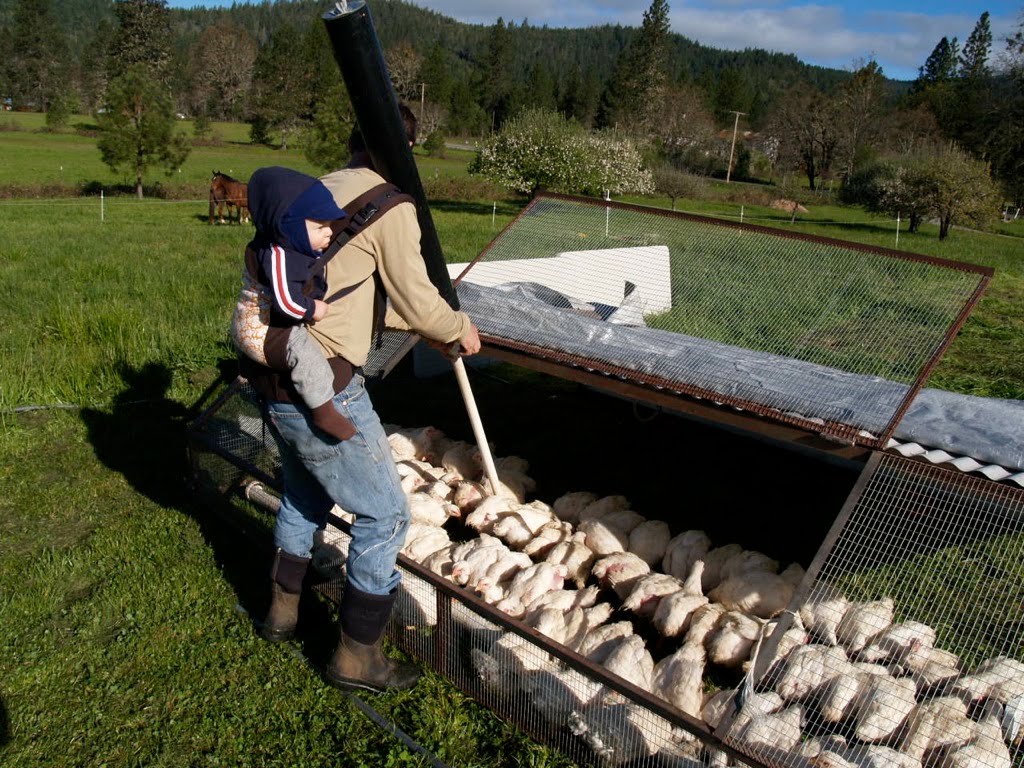
So, how to fill the trough, when chickens are clucking and bawking and flapping all over, eager for food, became kind of a big issue. It was clear pretty quickly, especially as the birds got larger and larger, that filling the trough by hand was a hassle. To make feeding time easier (and to mitigate a lot of wasted feed), Milan created a special dispenser. A large tube at the top is filled with feed. A valve at the bottom of the large tube flows into a smaller tube. The trough itself is only hung on its ends, so there aren't any obstacles to navigate around to keep the smaller end of the tube in the trough.

Milan actually has to fake the chickens out at one end of the trough and then jump the dispenser tube to the other end to even be able to get the feed into the trough. Of course, Jack is often part of the process. He loves to hang around one side or the other and watch the whole thing.

Friday, March 26, 2010

Questions You May Be Asking

If you received our "chicken letter", we included a sheet that provided much of the below information about our operation here at Sojourn Farms. Please feel free to contact us with additional questions. We look forward to hearing from you.

Are these chickens organic?
Yes. From the first day the chicks arrive from the hatchery, they are supplied exclusively with certified organic feed. We use a combination of locally produced Rogue poultry mix, and whole grain wheat. The birds also graze on our 100 acres of clean pasture. While the pasture is not certified organic, Sojourn Farms' fields have been both herbicide and pesticide free for the nearly 20 years the farm has been the in the family.

What is pastured poultry?
Simply put, “pastured poultry” describes birds that spend their life out on pasture. Pastured chickens typically consume 20% of their diet in fresh grass, legumes, and bugs, all of which satisfy their natural appetite. They can scratch around, pull worms… in short, be real chickens.

Is this “free range”?
Yes. The government standard for “free range” only requires that the birds have access to a small yard area for the last two weeks of life. There is no requirement that the birds actually ever see the light of day or touch a blade of grass, and in fact many never do. Our methods go beyond this standard by raising them on the range within 48 hours of arriving from the hatchery.

How does our product compare to store-bought chicken?
Most poultry that you buy in the supermarket has been chilled in a water bath causing the skin and meat to absorb up to 12% water. In contrast, our birds are air chilled, giving you more meat for your money. Proportionally, our chicken will have same large breasts and thighs you have come to expect. The meat is similarly white, but typically moister and firmer due to better muscle tone and less water. Our broilers are delivered chilled in a shrink-wrap bag ready for the freezer or cooking.

Why is our price higher?
Raising a chicken on quality organic feed and whole grains costs more than one raised on pellets. Moving them daily to fresh pasture takes more effort than shutting them in a stationary pen. We also allow our birds over 50% more time to physically develop, avoiding many of the health problems that plague mainstream practices. In order to cut costs, commercial animals are fed an unnaturally rich diet, causing them to attain slaughter weight within the first 6 weeks of life. This pattern of growth is so unhealthy for the bird, that often, had the bird not been slaughtered young, it would have soon died on its own. Our method is more labor intensive and costs more, but we feel it is best for the animal, the environment, and our customers.

Do you use antibiotics or arsenic (trade name Roxarsone)?
No. Both of these additives (antibiotics for disease control and arsenic for rapid growth) are answers to problems that do not exist in our method of husbandry. Instead, we rely on nature’s recipe for good health. We provide our animals a diet rich in fresh greens and whole grain. Their bedding is changed daily; they have plenty of room to exercise and time to relax in the Oregon summer sunshine.

How are the animals processed?
Butchering takes place on the farm where the chickens were raised. This is most humane for the animal, and eliminates the off taste that transportation stress can cause in the meat. At the time of slaughter, the bird is humanely knocked unconscious with a specially developed electric pulse. Once dressed, they are quickly cooled using modern sanitary equipment.